04:

André Kertész | Landing Pigeon, New York, 1960
This was taken around 59th Street where they had demolished the houses, and I saw a pigeon flying in and out. The original idea for this photograph dates back to my days in Paris, where I also saw some old run-down houses and wanted to photograph them with a pigeon. But the pigeon never came. Here in New York I sat and waited. Time and time again I went back to the same place, but it was never right. Then one day I saw the lonely pigeon. I took maybe two or three pictures. The moment was here. I had waited maybe thirty years for that instant.
-André Kertész, Kertész on Kertész
24:
Once, Henri [Cartier-Bresson] rang me in Paris and said, ‘Josef, [André] Kertész is in town, you must come to dinner and meet him.’ I said, ‘Henri, I love his pictures but I do not need to meet him.’ ‘No, you do not understand, you have to meet him because we three, we are of the same family.’ At the time, this seems to me to be an unbelievable thing to say. Now, though, when I look back from a distance, I can see that maybe there is something in that.
-Josef Koudelka

Stairs of Montmartre, Paris 1925, André Kertész

PRAGUE, Czechoslovakia—1992. © Josef Koudelka / Magnum Photos

Hyères, France, 1932 © Henri Cartier-Bresson / Magnum Photos
17:

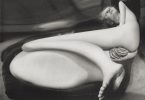
André Kertész | New York City, 1979
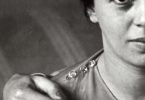
Everything that surrounds you can give you something. Last summer I stayed in my room most of the time and I began playing around with things. Years ago I was given a little primitive Polaroid camera and I didn’t like it–it was for snapshots. But one day I took it out. I had discovered, in the window of a shop, a little glass bust, and I was very moved because it resembled my wife–the shoulder and the neck were Elizabeth. For months and months I looked at the bust in the window and I finally bought it. The lady in the shop said, ‘It’s a beautiful bust, sir.’ ‘I know,’ I said. And I took it home, put it in my window, and began shooting and shooting with the Polaroid camera–in the morning, in the afternoon, in different lights. Something came out of this little incident, this little object. They made a book of all the pictures I took. It is dedicated to my wife. Look how the face of the bust is always changing: a shadow, which is the shadow of the curtain, then a passing cloud.
The sky and its reflection give it the expression. I didn’t arrange this thing–it was “there”. Photography cannot make nature more beautiful. Nature is the most beautiful thing in the world. You can show the beauty, illustrate it, but it is never the real beauty–very far from it. We don’t know how beautiful nature really is. We can only guess. I am always saying the best photographs are those I never took.
-André Kertész, Kertész on Kertész
17:

André Kertész | Satyric Dancer, Paris, 1926
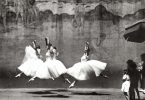
This picture of Magda was also taken in Beöthy’s studio. I said to her, ‘Do something with the spirit of the studio corner,’ and she started to move on the sofa. She just made a movement. I took only two photographs. No need to shoot a hundred rolls like people do today. People in motion are wonderful to photograph. It means catching the right moment–the moment when something changes into something else. It shows a kind of distortion similar to that in the photograph of the swimmer.
-André Kertész, Kertész on Kertész
27:

André Kertész | Washington Square, New York, 1954
My wife and I found the apartment, which I still live in [Kertész passed away in 1985], in 1952. I take many pictures from my balcony. It looks down onto Washington Square.
-André Kertész, Kertész on Kertész
10:

André Kertész | Broken Plate, Paris, 1929
In this picture of Montmartre, I was just testing a new lens for a special effect. When I went to America, I left most of my material in Paris, and when I returned I found sixty percent of the glass-plate negatives were broken. This one I saved, but it had a hole in it. I printed it anyways. And accident helped me to produce a beautiful effect.
-André Kertész, Kertész on Kertész
17:

Rainy Day, Tokyo, 1968, André Kertész
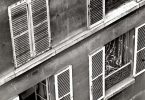
You do not have to imagine things; reality gives you all you need. I was in Tokyo. It was a rainy day, and I had just bought a new lens. I took some test shots out of the window of my hotel when I saw these people crossing the street–a perfect composition.
-André Kertész, Kertész on Kertész
13:

Underwater Swimmer Esztergom,1917, André Kertész
After I was wounded [in WWI] I was in the hospital for almost nine months. We went swimming in the pool every day, and I realized the distortions in the water. When I photographed them my comrades said, ‘You are crazy. Why did you photograph this?’ I answered: ‘Why only girl friends? This also exists.’ So I photographed my first distortion in 1917 – others followed later, especially the nudes in 1933.
-André Kertész, Kertész on Kertész
30:
I had the great pleasure of seeing a vintage print of Chez Mondrian in person at a gallery in Los Angeles. Not behind glass, framed on a wall but pulled from a vellum sleeve inside a photo box. I was flush at the time and contemplating buying one of my favorite photos.
I did not purchase it. But I will someday.

Chez Mondrian, Paris, 1926, André Kertész
I went to his studio and instinctively tried to capture in my photographs the spirit of his paintings. He simplified, simplified, simplified. The studio with its symmetry dictated the composition. He had a vase with a flower, but the flower was artificial. It was colored by him with the right color to match his studio.
-André Kertész, Kertész on Kertész
08:
Ah, the shadow self-portrait. I’ve done it. I know you’ve done it. Flickr and Facebook are filled with them. We are all so clever and artsy.
We are also just rehashing some old, tired ground. I am convinced there are many more of these self-portraits by the big name shooters. I will find them and post them. I will be curious to see which is the earliest one I can find. So far, Kertész is in the lead but that is not surprising.

Self-portrait, 1986, Colorado © John Vink/ Magnum Photos

Shadow Self Portrait, 1927, Andre Kertesz

Self-Portrait, Monument Valley, Utah, 1958, Ansel Adams